That $20 Lunch Wasn't Just $20
We tend to think in dollars because that's how the world prices things. But money is really a representation of something far more valuable: your time.
We tend to see and think things just in dollars because everything is priced that way. A coffee is $5. Lunch is $20. Shoes are $120. A phone is $1,200.
Those numbers are everywhere: on receipts, websites, menus and bank statements. But money is a representation of something more valuable: your time. If you start shifting your perspective on money, the way you think about spending can change.
Your Most Valuable Resource Isn't Money
Money can be earned again. Investments can recover. Businesses can be rebuilt.
Time can't. Every second, hour or moment is gone forever.
Every day, we trade pieces of our limited time for money. Maybe that's through a job, tutoring, freelancing, building a business or creating something you're proud of. However, no matter what method you use to make money, the exchange is always the same: you give some of your life in exchange for money.
And in that sense, money is stored time as every time you spend money, you're really spending something else too.
Ask a Different Question
Whenever we want to buy something, we usually ask: Can I afford it? That is useful, but it only tells you whether you have enough money. A better question can be:
How much of my life does this cost?
This single question created Money is Time. Instead of seeing money as an abstract number, you see the time and effort that created it. And once you start doing that, even an ordinary lunch can look a little different.
What Does a $20 Lunch Really Cost?
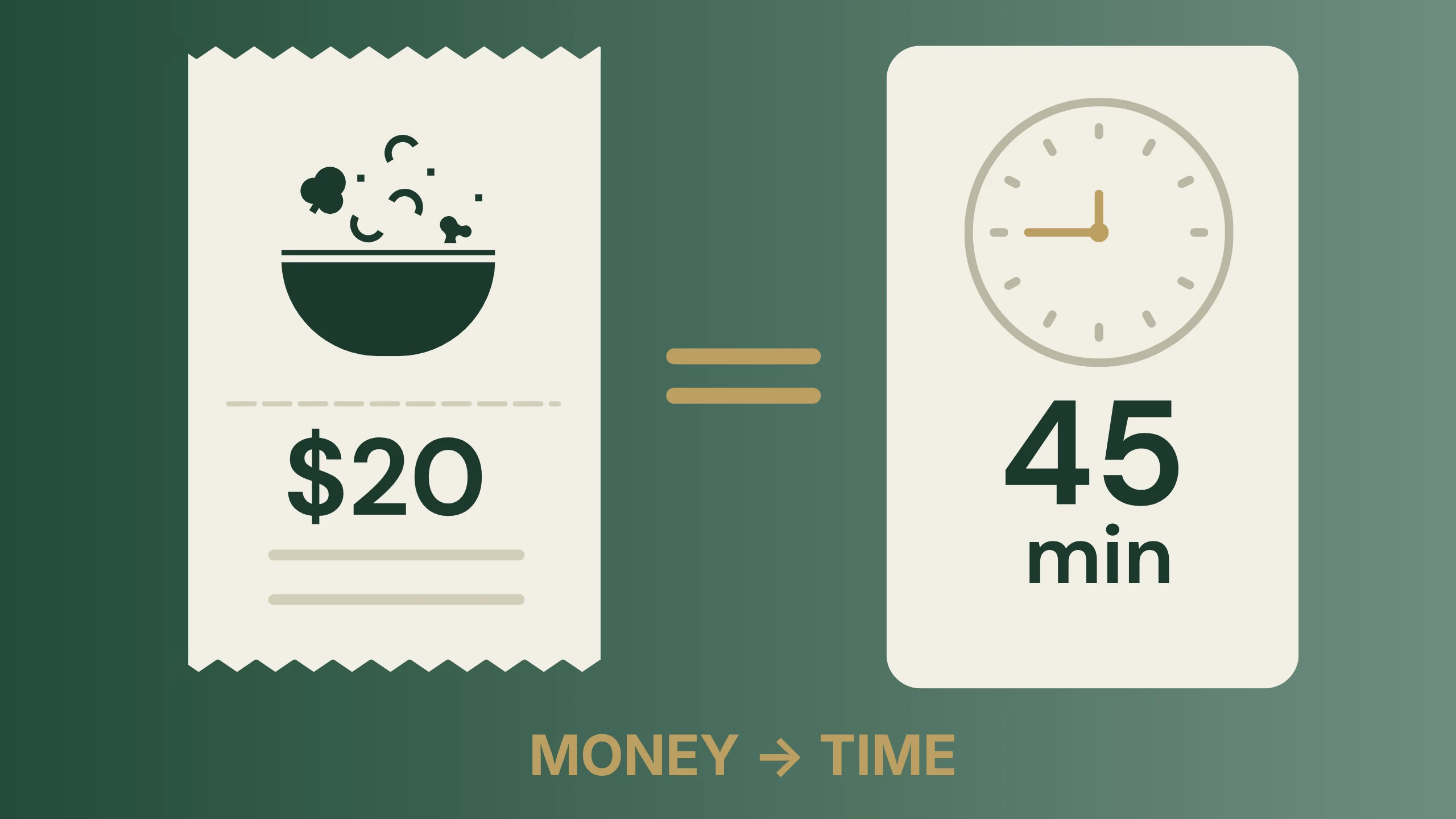
Imagine you earn $20 an hour and buy a $20 lunch. Financially, you spent $20. From a time perspective, you spent one hour of hard work to earn enough to pay for it.
A $20 lunch at $20/hour = 1 hour of work.
Now imagine you buy that lunch twice a week. That's $40 a week, or about $2,080 a year. At $20 an hour, that's roughly 104 hours of work. More than four full days.
That doesn't mean the lunches were a bad decision. Maybe they saved you time. Maybe you ate with a friend. Maybe you were celebrating something. Maybe the experience was genuinely worth it.
The point isn't to make you feel guilty. It's to make the cost visible.
And once the cost becomes visible, you can start comparing it with what you're actually getting in return.
Everything Has a Time Price
That same idea applies to almost everything you buy. If you earn $20 an hour:
- $5 coffee → 15 minutes
- $40 dinner → 2 hours
- $120 shoes → 6 hours
- $300 console → 15 hours
- $1,200 phone → 60 hours
- $2,000 vacation → 100 hours
And these are simple calculations. Taxes, commuting, energy and other costs can make the real time price even higher. But the purpose isn't to turn every purchase into a calculation. It's to change what the number means.
$120 isn't just $120 anymore. It's six hours of work. And that naturally leads to a more important question:
Was it worth it?
Spending Isn't the Enemy
There's a danger in taking this idea too far. If you calculate the time cost of everything, you could end up feeling guilty every time you spend money. That's not what I want.
Because once you understand the time behind your money, the goal shouldn't be to avoid spending it. The goal should be to spend it on things that are actually worth your time and improving your life.
A healthy meal can be worth it. Education can be worth it. A tool that saves you hours can be worth it. A vacation with people you love can be worth it. Even something completely unnecessary can be worth it if the enjoyment matters to you.
The problem isn't spending money. It's spending without intention. The goal isn't to spend less. It's to spend better. To spend to create your life.
What Are You Really Buying?
Thinking in time also changes how you evaluate what you're buying. Every purchase gives you something in return.
- $20 lunch → convenience or experience
- $100 concert ticket → an experience
- $500 laptop → productivity
- $2,000 vacation → memories
So the price is only half of the equation. The other half is what you're getting for it.
Before a bigger purchase, consider:
- How many hours of my life does this cost?
- Will I be glad I bought this later?
- Does it improve my life or satisfy a temporary want?
- Does it align with what I actually value?
- What am I giving up by spending this money?
You don't need to ask these questions before buying every sandwich or coffee. It's about developing a different mental model, one that makes the trade-off easier to see.
And once you start looking at your spending this way, something else becomes apparent: your spending reveals your priorities.
Your Spending Reveals Your Priorities
We all have things we say we value. Family. Health. Experiences. Education. Freedom. Creativity.
But our spending can sometimes tell a different story. You might say family is your highest priority, but spend very little money creating time with them. You might say your health matters, but consistently spend more on convenience than on things that support it. You might say you want to start a business, but continually spend the money that could give you the freedom to pursue it.
There's nothing inherently wrong with these choices. But your spending tells a story.
Where your money goes is often a reflection of where your life goes.
That's why tracking money isn't just accounting. It's awareness. And if money represents your time, then managing your money is, in a way, managing how you trade your time.
Saving Money Is Buying Freedom
Saving is often presented as simply making your bank account bigger. But a bigger number isn't the ultimate goal. Freedom is.
Money can give you the ability to leave a job you hate, take time off, pursue something meaningful, spend more time with family, or simply say no.
The greatest return from saving isn't always the interest you earn. Sometimes it's the options you create.
Every dollar you save is a little more flexibility over your future. And the more financial flexibility you have, the more control you can have over your time.
Real Wealth Is Control Over Your Time
This changes how I think about wealth. We often measure it through things we can see: a bigger house, a nicer car, a more expensive watch or a larger investment portfolio.
But I think there's another definition that matters more:
How much control do you have over your time?
- Can you spend an afternoon with someone you love without worrying about work?
- Can you pursue a project because you genuinely care about it?
- Can you take a break when you need one?
- Can you say no to something that isn't worth your time?
If money helps you answer yes to more of those questions, it's creating something valuable. It's creating freedom.
But if having more money constantly requires giving up more of your life to earn it, are you actually becoming wealthier?
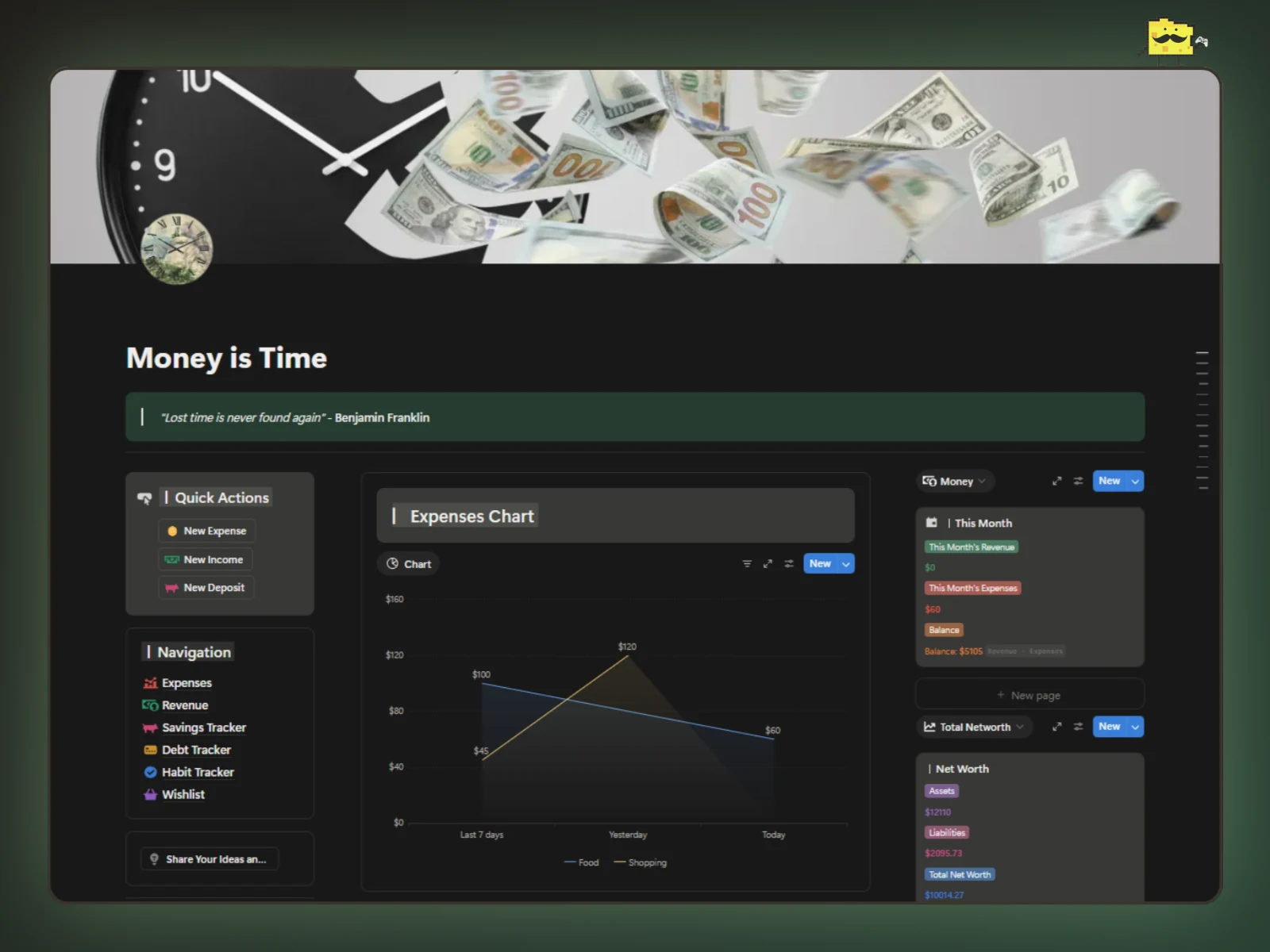
Why I Built Money is Time
This is the question I wanted Money is Time to help people think about.
I didn't want to build another expense tracker that simply tells you: You spent $47.82 on restaurants this month.
I wanted to help you understand what that money represents. Money is Time connects financial decisions to the resource you're ultimately trying to protect: your time.
Because a budget isn't just a collection of numbers. It's a plan for your life.
When you decide where your money goes, you're deciding what portions of your life you're willing to trade for those things.
When you save, you're not simply keeping money in an account. You're buying future choices.
A Different Way to Think About Money
Ultimately, Money is Time isn't about convincing you to stop spending. It's about helping you spend consciously.
- Buy the coffee if you love it.
- Go to the restaurant if the experience matters.
- Buy the game if you'll genuinely enjoy playing it.
- Take the vacation if the memories are worth it.
Just know what you're exchanging.
Because once you understand the time behind your money, you can make decisions based on something more meaningful than whether your bank account says yes or no.
You can ask whether your life says yes, not just whether your bank account does.
Was That $20 Lunch Worth It?
Maybe. And that's the point. The answer isn't always no. Sometimes $20 is worth an hour of your life. Sometimes it isn't.
What matters is knowing that you're making the trade. Because every purchase is more than a financial decision.
It's a life decision.
So the next time you're about to buy something, don't just ask: Can I afford it?
Is this worth a piece of my life?